papersResearch Blueprints
A complete archive of published papers and technical reports, organized as buildable blueprints by year.
2026
LoopNav: Benchmarking Spatial Consistency in World Models
Kewei Lian, Shaofei Cai, Yitao Liang, Anji Liu
Conference on Neural Information Processing Systems (NeurIPS'26) 2026 (Accepted; proceedings forthcoming)
A loop-navigation dataset and benchmark for evaluating spatial consistency in world models. Minecraft trajectories revisit locations from different views, while a scene-graph metric measures consistency beyond pixel-level similarity.
UniCode: Augmenting Evaluation for Code Reasoning
Xinyue Zheng*, Haowei Lin*, Shaofei Cai, Yaodong Yang, Zilong Zheng#, Yitao Liang# (* equal contribution, # corresponding author)
International Conference on Machine Learning (ICML'26) 2026
A generative evaluation framework that augments programming problems across reasoning dimensions. Scalable test generation and diagnostic metrics probe robustness under structural shifts and expose reliance on memorized solutions.
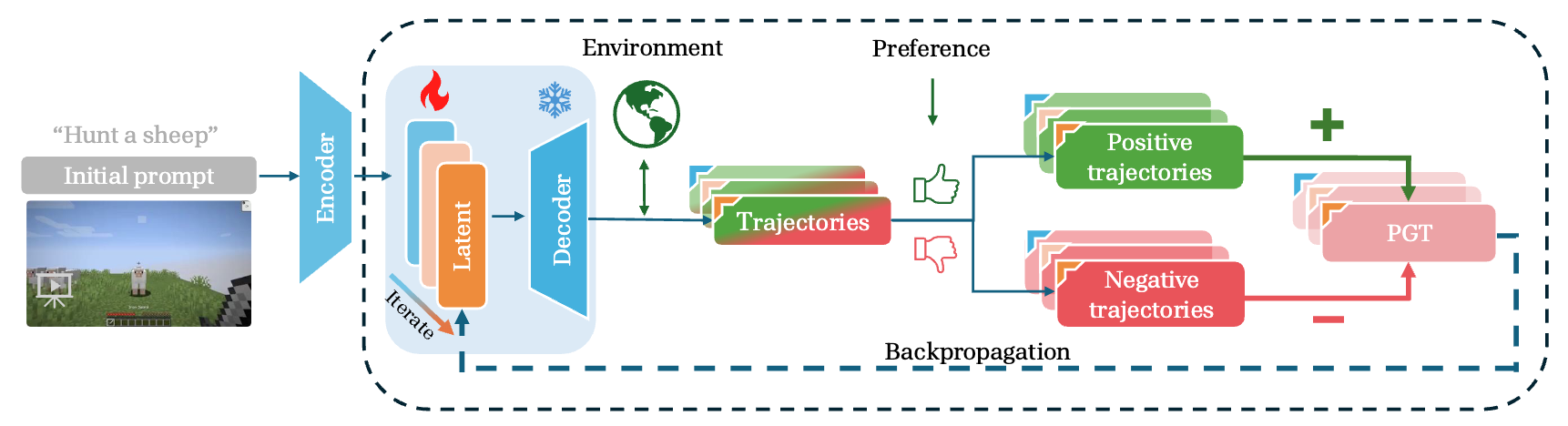
Preference Goal Tuning: Post-Training as Latent Control for Frozen Policies
Guangyu Zhao*, Kewei Lian*, Haoxuan Ru*, Borong Zhang*, Haowei Lin, Zhancun Mu, Haobo Fu, Qiang Fu, Shaofei Cai, Zihao Wang, Yitao Liang (* equal contribution)
International Conference on Machine Learning (ICML'26) 2026
Preference Goal Tuning adapts a frozen goal-conditioned policy by optimizing its latent goal from trajectory preferences. It improves task alignment with limited rollout data while retaining the policy's out-of-distribution robustness.
CUARewardBench: A Benchmark for Evaluating Reward Models for Computer-Using Agents
Haojia Lin*, Xiaoyu Tan*, Yulei Qin*, Zihan Xu, Yuchen Shi, Zongyi Li, Gang Li, Shaofei Cai, Siqi Cai, Yuzheng Cai, Chaoyou Fu, Ke Li, Xing Sun (* equal contribution)
International Conference on Machine Learning (ICML'26) 2026
Benchmarks outcome and process reward models for computer-using agents with human-annotated trajectories across software categories. Unanimous Prompt Ensemble combines consistent judgments across prompts to improve verification reliability.

DeepSeek-V4.1-Flash: Pushing the Limits of KV Cache Compression
DeepSeek-AI (including Shaofei Cai)
Technical Report (arXiv) 2026
A multimodal mixture-of-experts model designed for input-heavy, long-horizon agents. A causal encoder-decoder architecture, cross-layer KV reuse, FP4 caching, and bounded replay reduce prefill and KV-cache costs while retaining million-token contexts.
DeepSeek-V4: Towards Highly Efficient Million-Token Context Intelligence
DeepSeek-AI (including Shaofei Cai)
Technical Report (arXiv) 2026
Introduces the Pro and Flash mixture-of-experts models with million-token contexts. Hybrid compressed attention, manifold-constrained hyper-connections, and Muon-based optimization improve long-context efficiency and support reasoning and long-horizon agentic workloads.
Learn the Ropes, Then Trust the Wins: Self-imitation with Progressive Exploration for Agentic Reinforcement Learning
Yulei Qin, Xiaoyu Tan, Zhengbao He, Gang Li, Haojia Lin, Zongyi Li, Zihan Xu, Yuchen Shi, Siqi Cai, Renting Rui, Shaofei Cai, Yuzheng Cai, Xuan Zhang, Sheng Ye, Ke Li, Xing Sun
International Conference on Learning Representations (ICLR'26) 2026
SPEAR combines self-imitation and curriculum-based exploration for agentic reinforcement learning. It encourages early tool exploration and progressively emphasizes successful experience, improving long-horizon task learning.
CREATE: Cross-Layer Resilience Characterization and Optimization for Efficient yet Reliable Embodied AI Systems
Tong Xie, Yijiahao Qi, Jinqi Wen, Zishen Wan, Yanchi Dong, Zihao Wang, Shaofei Cai, Yitao Liang, Tianyu Jia, Yuan Wang, Runsheng Wang, Meng Li# (# corresponding author)
Architectural Support for Programming Languages and Operating Systems (ASPLOS'26) 2026
Studies fault tolerance across circuit, model, and application layers in embodied AI systems. It combines anomaly handling, resilient planning, and adaptive voltage scaling to reduce energy use while preserving task quality.
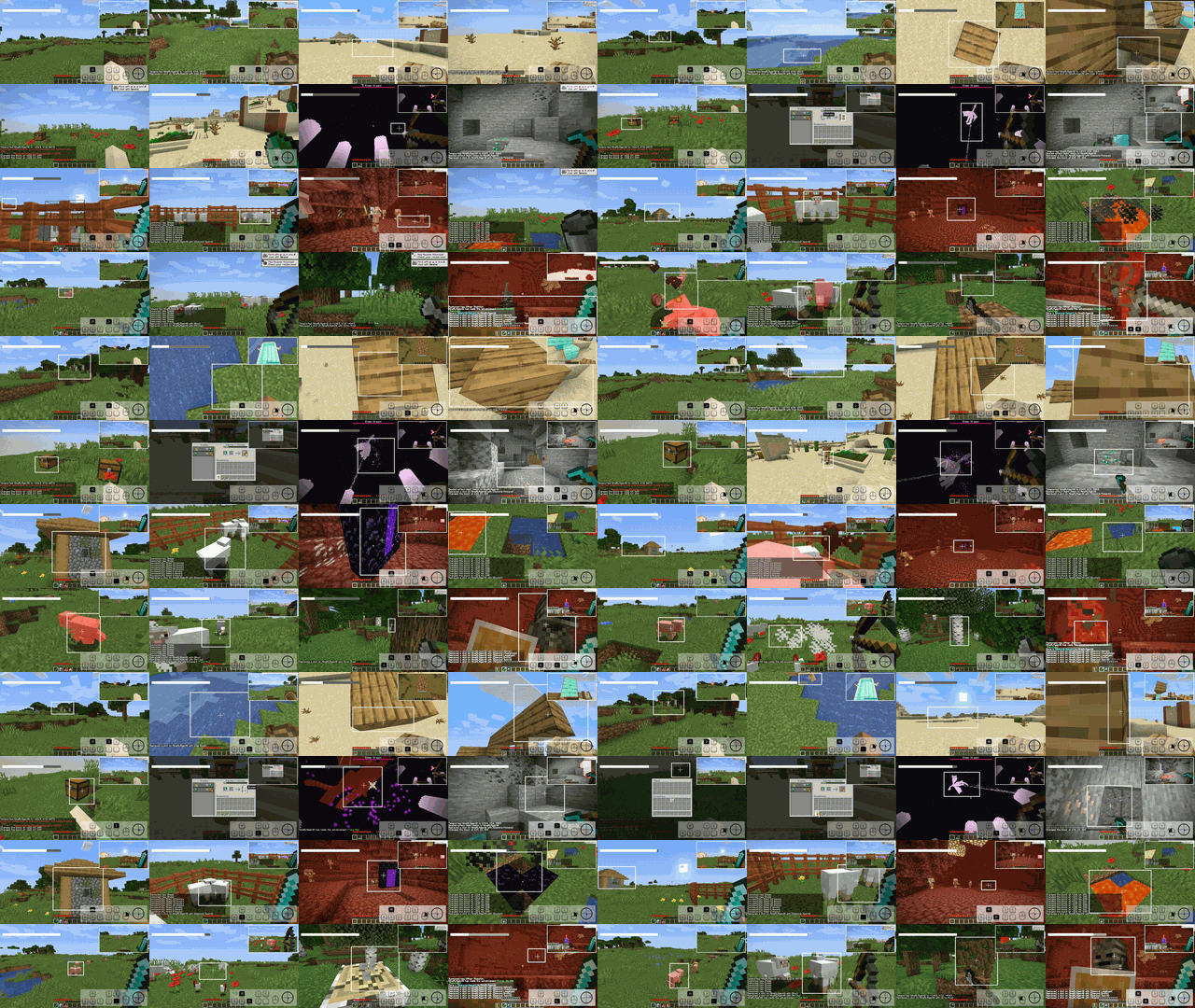
Steering Visuomotor Policy in Open Worlds via Cross-View Goal Alignment
Shaofei Cai, Zhancun Mu, Anji Liu, Yitao Liang
Proceedings of the AAAI Conference on Artificial Intelligence (AAAI'26) 2026
We aim to develop a goal specification method that is semantically clear, spatially sensitive, and intuitive for human users to guide agent interactions in embodied environments. Specifically, we propose a novel cross-view goal alignment framework that allows users to specify target objects using segmentation masks from their own camera views rather than the agent's observations.
2025
DeepSeek-V3.2: Pushing the Frontier of Open Large Language Models
DeepSeek-AI (including Shaofei Cai)
Technical Report (arXiv) 2025
Combines DeepSeek Sparse Attention with scalable reinforcement learning and large-scale agentic task synthesis to improve long-context efficiency, reasoning, and tool-using agents.

Scalable Multi-Task Reinforcement Learning for Generalizable Spatial Intelligence in Visuomotor Agents
Shaofei Cai*, Zhancun Mu*, Haiwen Xia, Bowei Zhang, Anji Liu, Yitao Liang (* equal contribution)
arxiv 2025
The first reinforcement learning trained multi-task policy in the Minecraft world, demonstrating zero-shot generalization capability to other 3D domains.
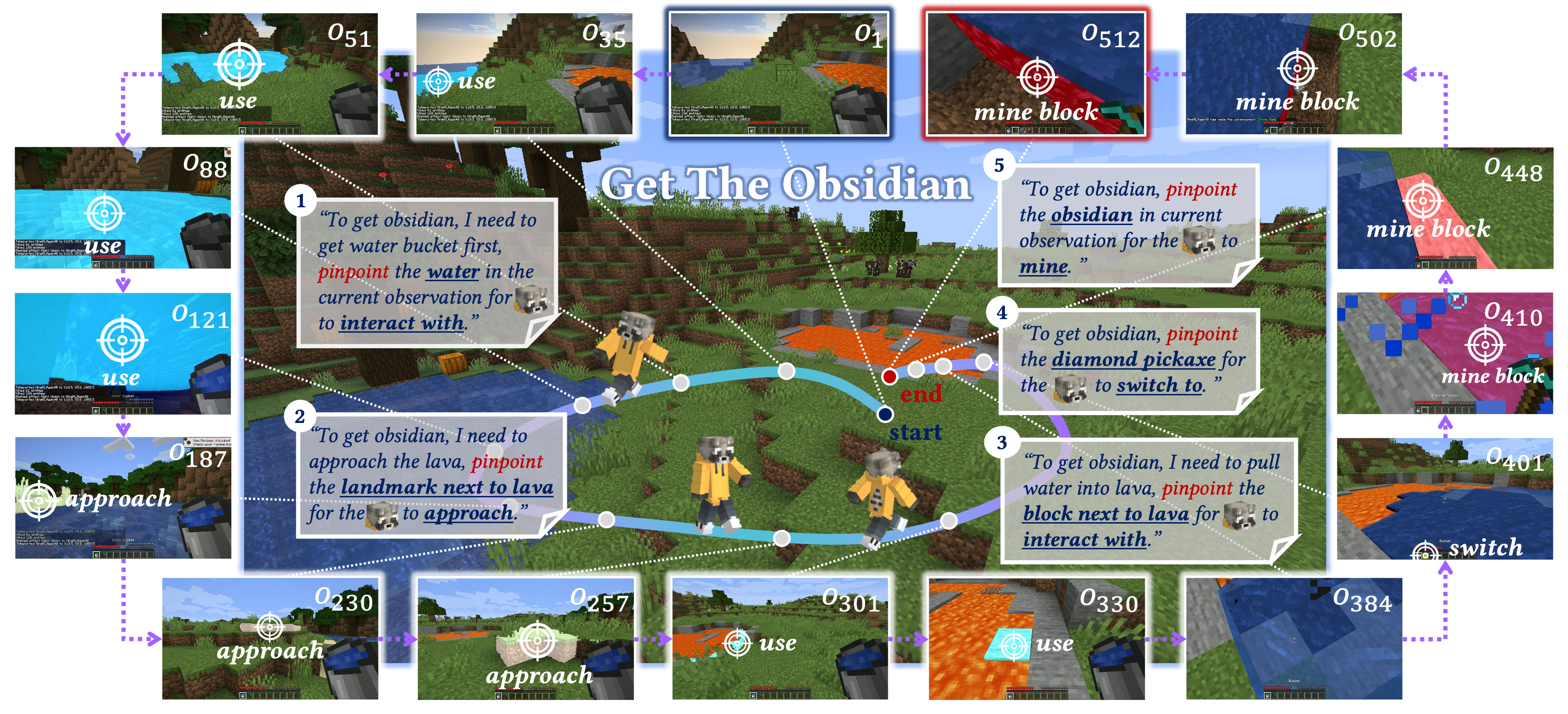
ROCKET-1: Mastering Open-World Interaction with Visual-Temporal Context Prompting
Shaofei Cai, Zihao Wang, Kewei Lian, Zhancun Mu, Xiaojian Ma, Anji Liu, Yitao Liang
IEEE/CVF Computer Vision and Pattern Recognition (CVPR'25) 2025
We propose visual-temporal context prompting, a novel communication protocol between VLMs and policy models. This protocol leverages object segmentation from past observations to guide policy-environment interactions. Using this approach, we train ROCKET-1, a low-level policy that predicts actions based on concatenated visual observations and segmentation masks, supported by real-time object tracking from SAM-2.
2024

MineStudio: A Streamlined Package for Minecraft AI Agent Development
Shaofei Cai*, Zhancun Mu*, Kaichen He, Bowei Zhang, Xinyue Zheng, Anji Liu, Yitao Liang (* equal contribution)
arxiv 2024
MineStudio is an open-source software package designed to streamline embodied policy development in Minecraft. MineStudio represents the first comprehensive integration of seven critical engineering components: simulator, data, model, offline pretraining, online finetuning, inference, and benchmark, thereby allowing users to concentrate their efforts on algorithm innovation.
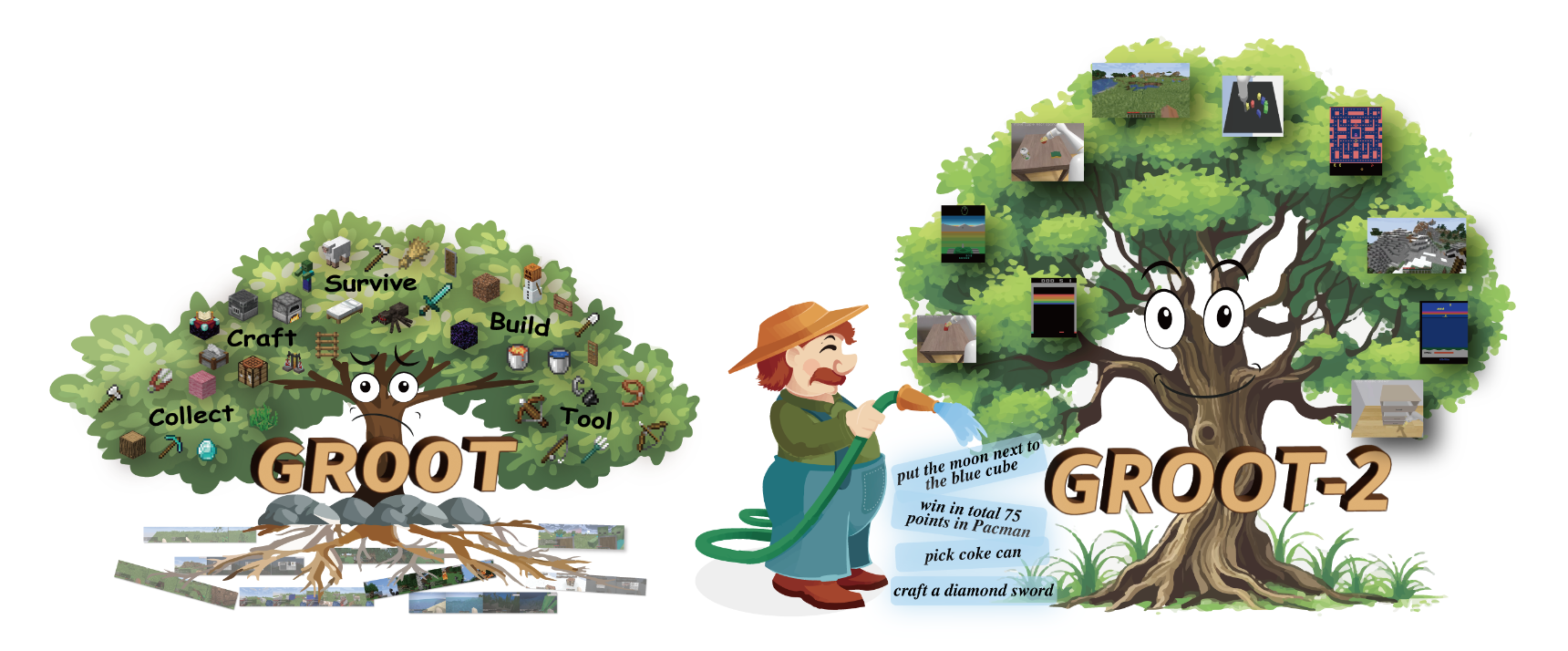
GROOT-2: Weakly Supervised Multi-Modal Instruction Following Agents
Shaofei Cai*, Bowei Zhang*, Zihao Wang, Haowei Lin, Xiaojian Ma, Anji Liu, Yitao Liang (* equal contribution)
International Conference on Learning Representations (ICLR'25) 2025
We frame the problem as a semi-supervised learning task and introduce GROOT-2, a multimodal instructable agent trained using a novel approach that combines weak supervision with latent variable models. Our method consists of two key components: constrained self-imitating, which utilizes large amounts of unlabeled demonstrations to enable the policy to learn diverse behaviors, and human intention alignment, which uses a smaller set of labeled demonstrations to ensure the latent space reflects human intentions.
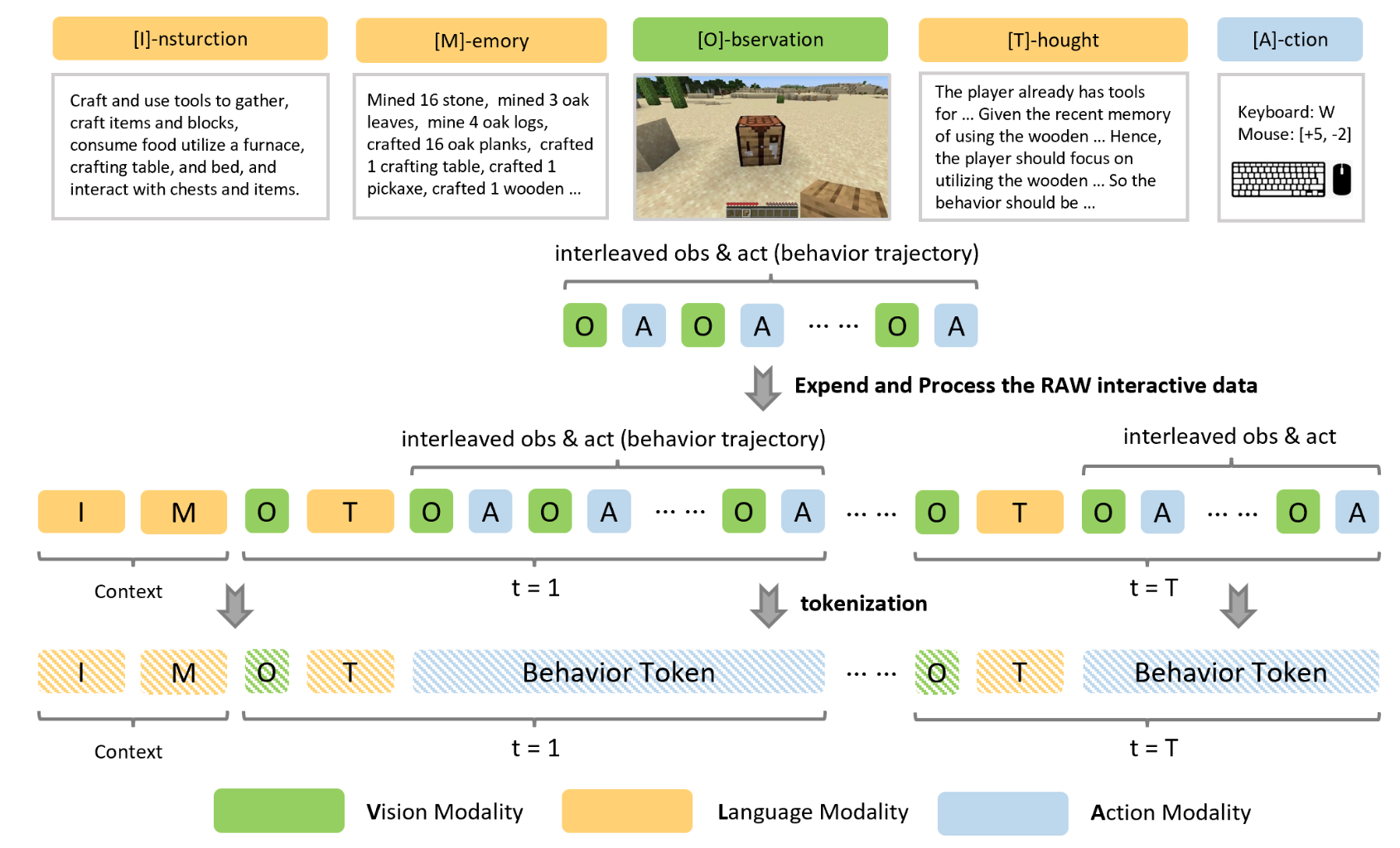
OmniJARVIS: Unified Vision-Language-Action Tokenization Enables Open-World Instruction Following Agents
Zihao Wang, Shaofei Cai, Zhancun Mu, Haowei Lin, Ceyao Zhang, Xuejie Liu, Qing Li, Anji Liu, Xiaojian Ma, Yitao Liang
Neural Information Processing Systems (NeurIPS'24) 2024
This paper presents OmniJARVIS, a novel Vision-Language-Action (VLA) model for open-world instructionfollowing agents in Minecraft. Compared to prior works that either emit textual goals to separate controllers or produce the control command directly, OmniJARVIS seeks a different path to ensure both strong reasoning and efficient decision-making capabilities via unified tokenization of multimodal interaction data.
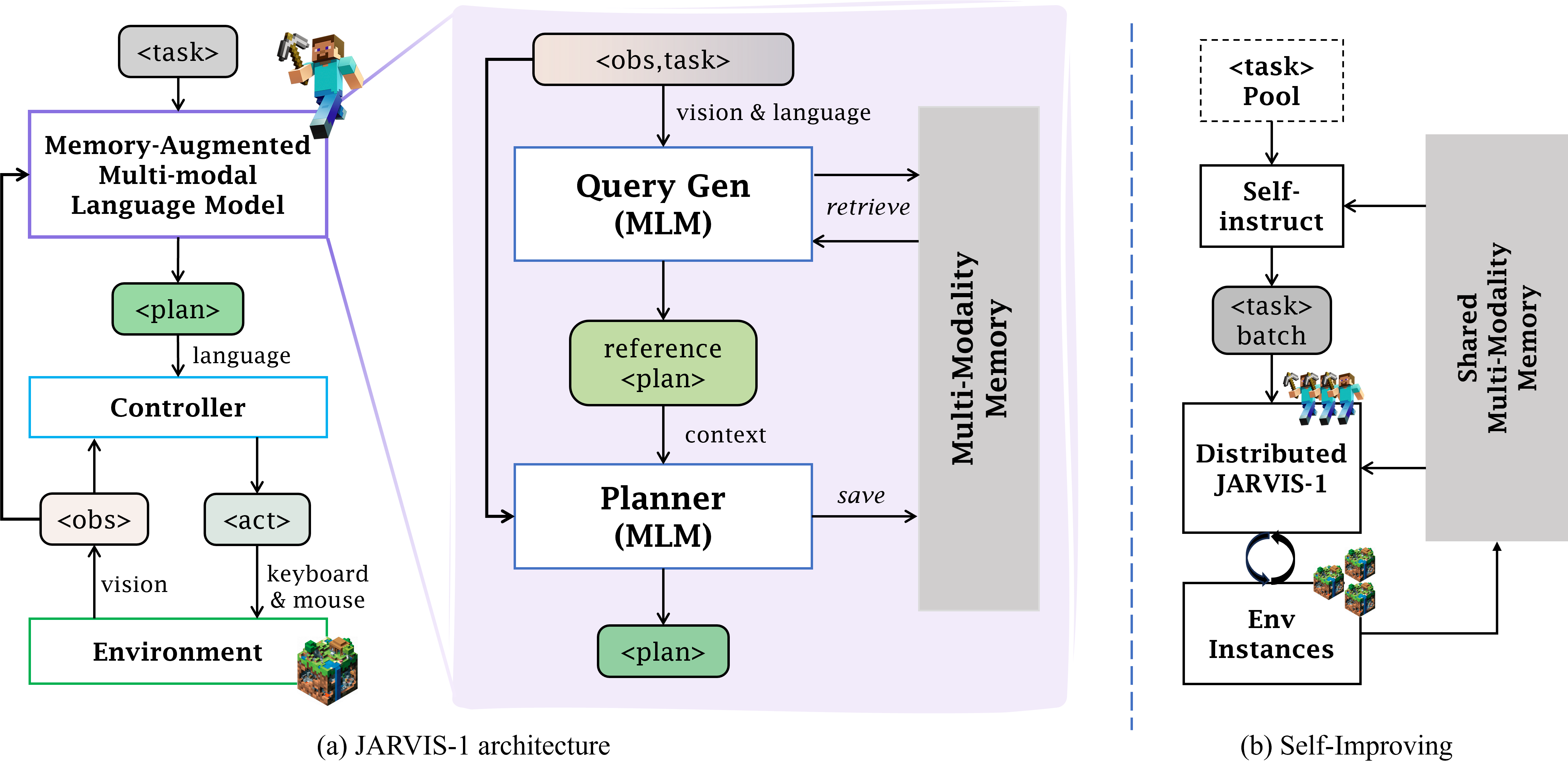
JARVIS-1: Open-World Multi-task Agents with Memory-Augmented Multimodal Language Models
Zihao Wang, Shaofei Cai, Anji Liu, Yonggang Jin, Jinbing Hou, Bowei Zhang, Haowei Lin, Zhaofeng He, Zilong Zheng, Yaodong Yang, Xiaojian Ma, Yitao Liang
IEEE Transactions on Pattern Analysis and Machine Intelligence (TPAMI'24) 2024
This paper introduces JARVIS-1, an open-world agent that can perceive multimodal input (visual observations and human instructions), generate sophisticated plans, and perform embodied control, all within the popular yet challenging open-world Minecraft universe. Specifically, we develop JARVIS-1 on top of pre-trained multimodal language models, which map visual observations and textual instructions to plans. The plans will be ultimately dispatched to the goal-conditioned controllers.
2023
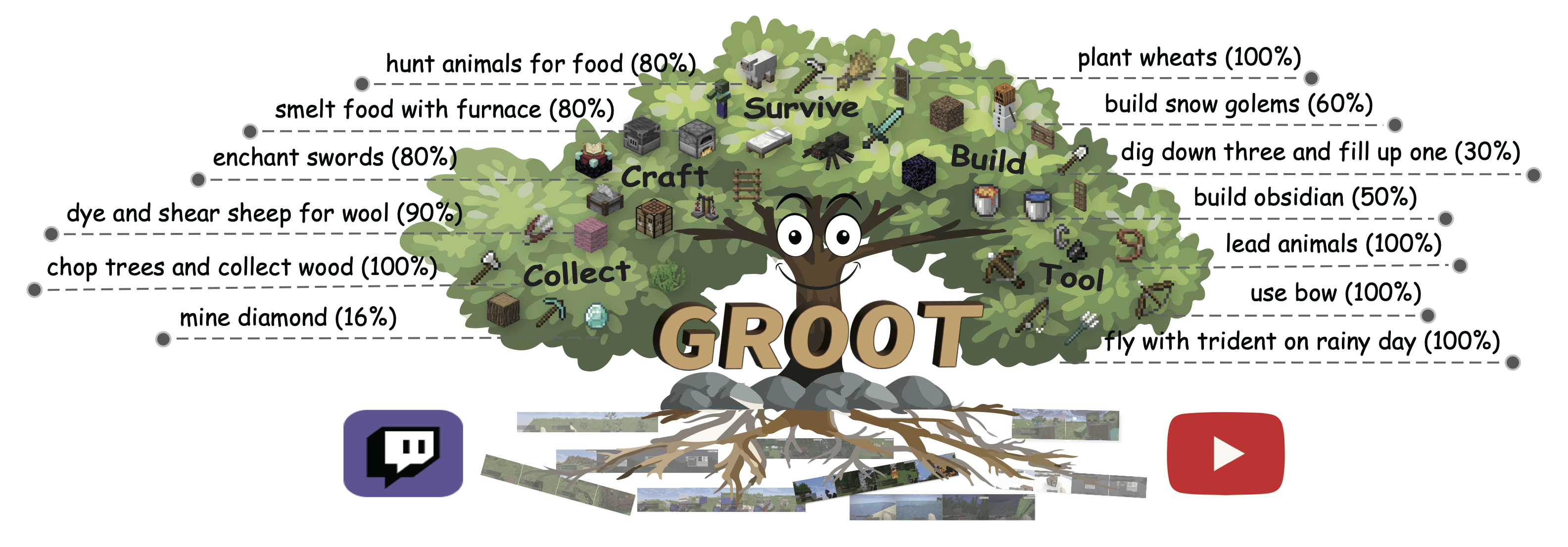
GROOT: Learning to Follow Instructions by Watching Gameplay Videos
Shaofei Cai, Bowei Zhang, Zihao Wang, Xiaojian Ma, Anji Liu, Yitao Liang
International Conference on Learning Representations (ICLR'24) 2024 Spotlight Top 6.2%
This paper studies the problem of building a controller that can follow open-ended instructions in open-world environments. We propose to follow reference videos as instructions, which offer expressive goal specifications while eliminating the need for expensive text-gameplay annotations. A new learning framework is derived to allow learning such instruction-following controllers from gameplay videos while producing a video instruction encoder that induces a structured goal space.
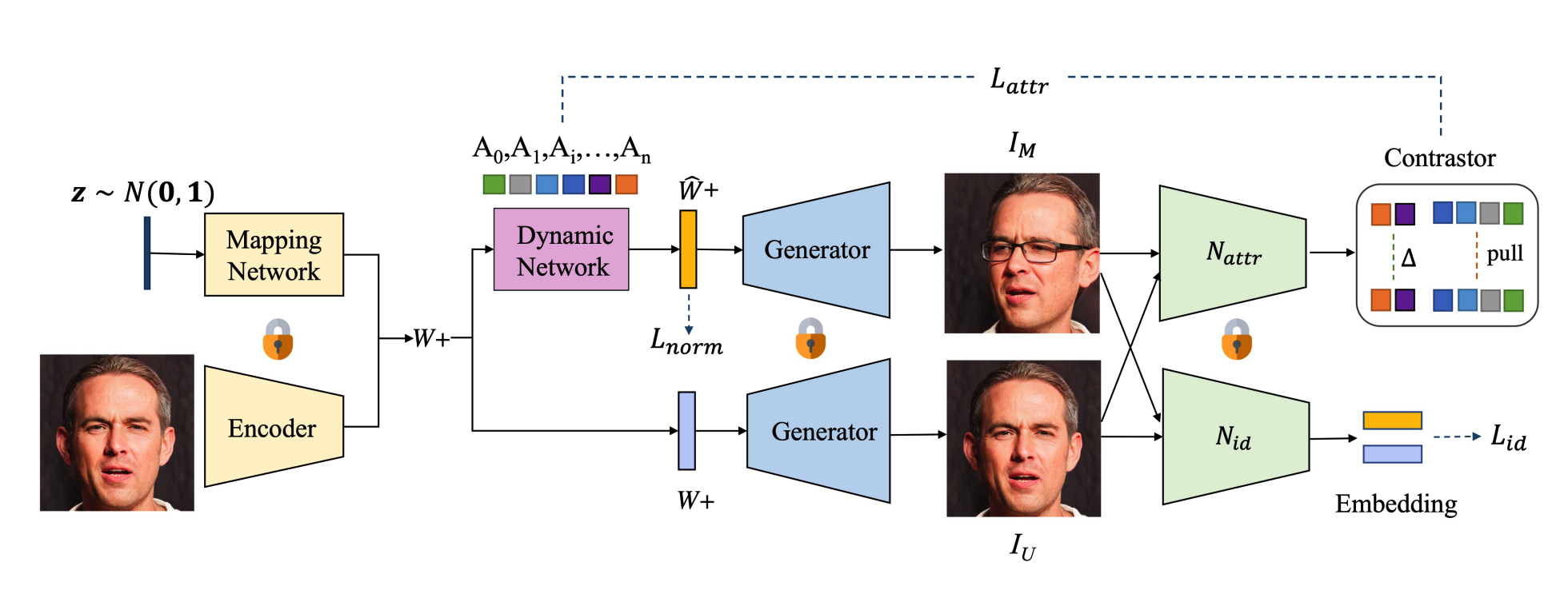
DyStyle: Dynamic Neural Network for Multi-Attribute-Conditioned Style Editing
Bingchuan Li*, Shaofei Cai*, Wei Liu, Peng Zhang, Miao Hua, Qian He, Zili Yi (* equal contribution)
IEEE/CVF Winter Conference on Applications of Computer Vision (WACV'23) 2023
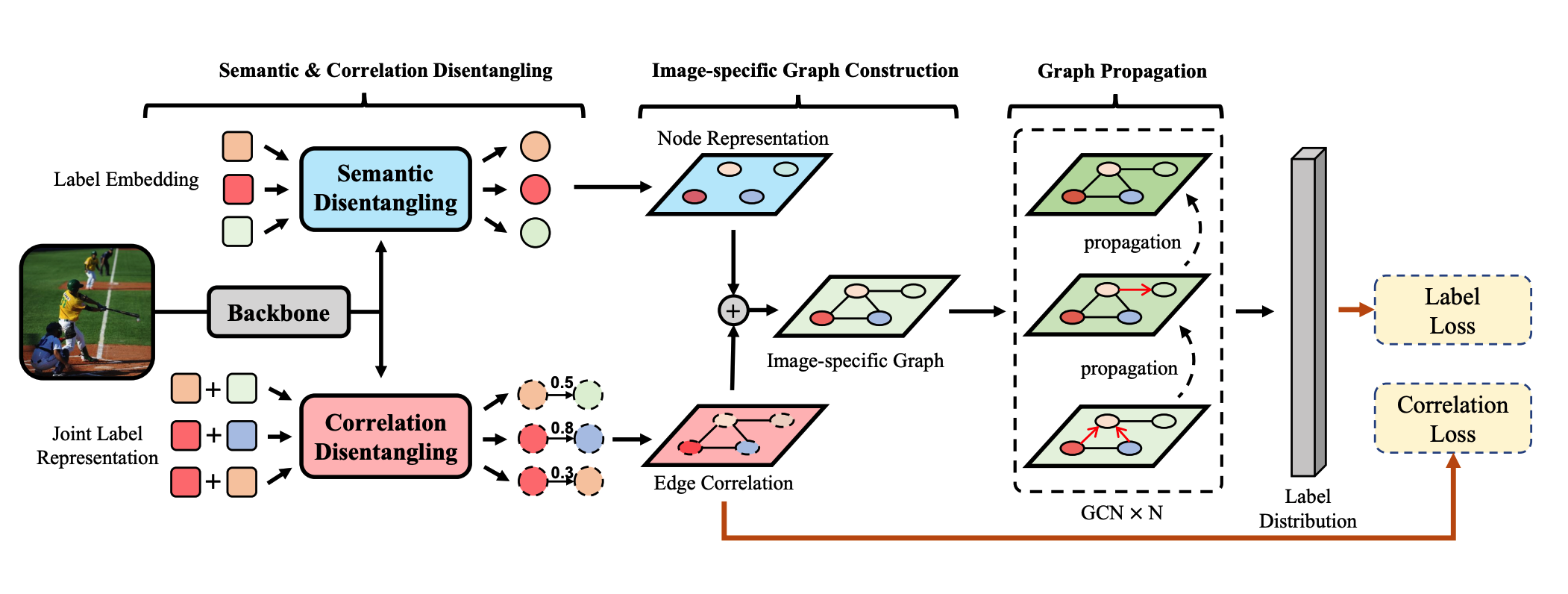
This paper proposes a semantic and correlation disentangled graph convolution method, which builds the image-specific graph and employs graph propagation to reason the labels effectively. We introduce a semantic disentangling module to extract category-wise semantic features as nodes and a correlation disentangling module to extract image-specific label correlations as edges. Performing graph convolutions on this image-specific graph allows for better mining of difficult labels with weak visual representations.
Semantic and Correlation Disentangled Graph Convolutions for Multilabel Image Recognition
Shaofei Cai, Liang Li, Xinzhe Han, Shan Huang, Qi Tian, Qingming Huang
IEEE Transactions on Neural Networks and Learning Systems (TNNLS'23) 2023
This paper proposes a semantic and correlation disentangled graph convolution method, which builds the image-specific graph and employs graph propagation to reason the labels effectively. We introduce a semantic disentangling module to extract category-wise semantic features as nodes and a correlation disentangling module to extract image-specific label correlations as edges. Performing graph convolutions on this image-specific graph allows for better mining of difficult labels with weak visual representations.
Describe, Explain, Plan and Select: Interactive Planning with Large Language Models Enables Open-World Multi-Task Agents
Zihao Wang, Shaofei Cai, Xiaojian Ma, Anji Liu, Yitao Liang
Neural Information Processing Systems (NeurIPS'23) 2023
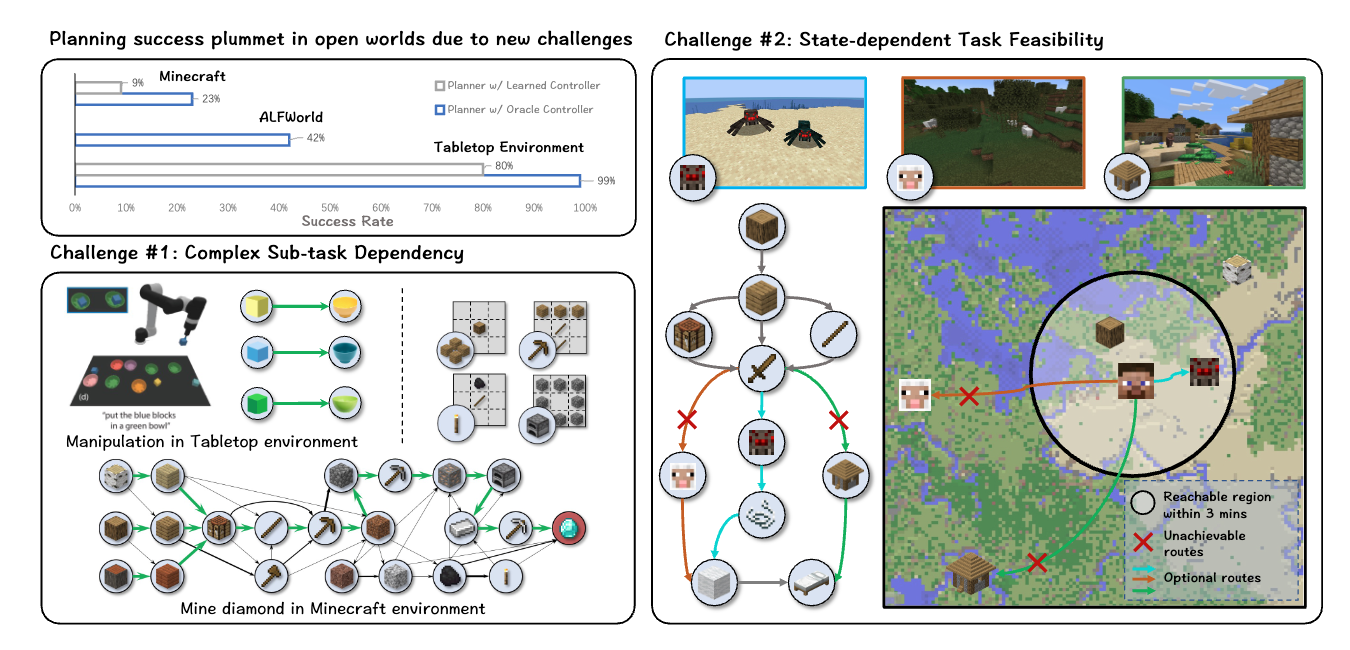
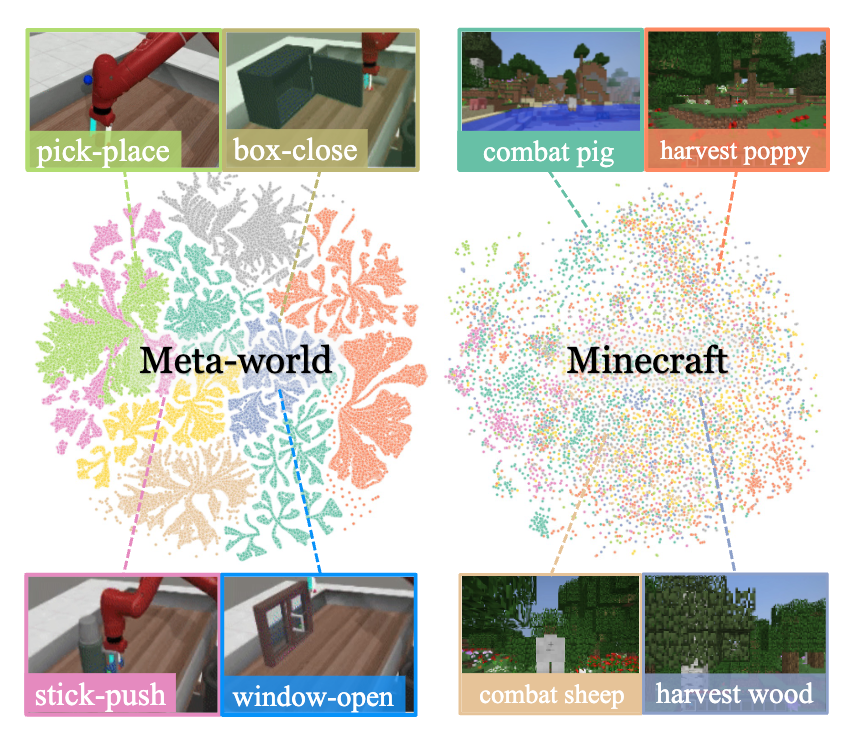
This paper identifies two main challenges of learning such policies: 1) the indistinguishability of tasks from the state distribution, due to the vast scene diversity,and 2) the non-stationary nature of environment dynamics caused by partial observability. For first challenge, we present Goal-Sensitive Backbone (GSB) for the policy to encourage the emergence of goal-relevant visual state representations. For the second challenge, the policy is further fueled by an adaptive horizon prediction module that helps alleviate the learning uncertainty.
Open-World Multi-Task Control Through Goal-Aware Representation Learning and Adaptive Horizon Prediction
Shaofei Cai, Zihao Wang, Xiaojian Ma, Anji Liu, Yitao Liang
IEEE/CVF Computer Vision and Pattern Recognition (CVPR'23) 2023
This paper identifies two main challenges of learning such policies: 1) the indistinguishability of tasks from the state distribution, due to the vast scene diversity,and 2) the non-stationary nature of environment dynamics caused by partial observability. For first challenge, we present Goal-Sensitive Backbone (GSB) for the policy to encourage the emergence of goal-relevant visual state representations. For the second challenge, the policy is further fueled by an adaptive horizon prediction module that helps alleviate the learning uncertainty.
2022
Automatic Relation-aware Graph Network Proliferation
Shaofei Cai, Liang Li, Xinzhe Han, Jiebo Luo, Zhengjun Zha, Qingming Huang
IEEE/CVF Computer Vision and Pattern Recognition (CVPR'22) 2022 Oral Top 4.2%
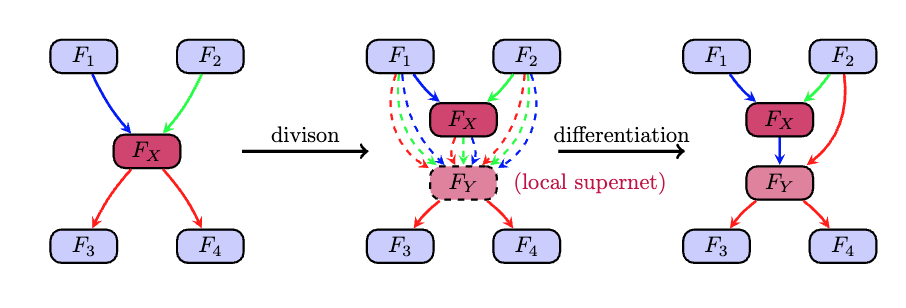
This paper proposes Automatic Relation-aware Graph Network Proliferation (ARGNP) for efficiently searching GNNs with a relation-guided message passing mechanism. Specifically, we first devise a novel dual relation-aware graph search space that comprises both node and relation learning operations. These operations can extract hierarchical node/relational information and provide anisotropic guidance for message passing on a graph. Second, analogous to cell proliferation, we design a network proliferation search paradigm to progressively determine the GNN architectures by iteratively performing network division and differentiation.
2021
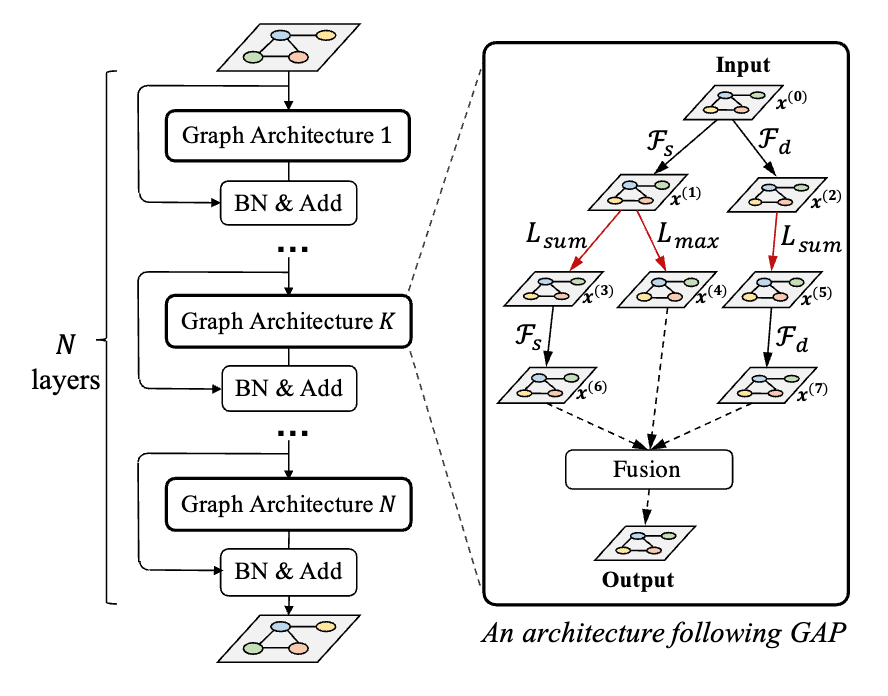
Rethinking Graph Neural Architecture Search from Message-Passing
Shaofei Cai, Liang Li, Jincan Deng, Beichen Zhang, Zhengjun Zha, Li Su, Qingming Huang
IEEE/CVF Computer Vision and Pattern Recognition (CVPR'21) 2021
This paper proposes Graph Neural Architecture Search (GNAS) with novel-designed search space. The GNAS can automatically learn better architecture with the optimal depth of message passing on the graph. Specifically, we design Graph Neural Architecture Paradigm (GAP) with tree-topology computation procedure and two types of fine-grained atomic operations (feature filtering & neighbor aggregation) from message-passing mechanism to construct powerful graph network search space.
2020
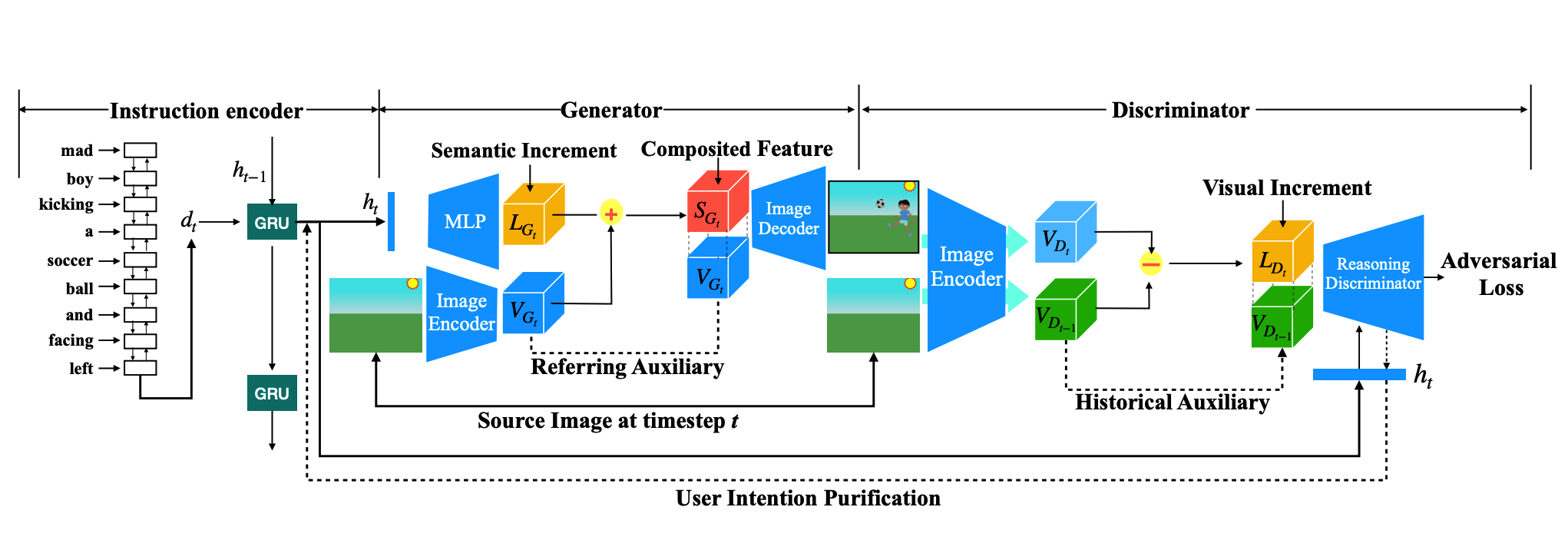
IR-GAN: Image Manipulation with Linguistic Instruction by Increment Reasoning
Zhenhuan Liu, Jincan Deng, Liang Li, Shaofei Cai, Qianqian Xu, Shuhui Wang, Qingming Huang
ACM International Conference on Multimedia (MM'20) 2020 Oral
Traditional conditional image generation models mainly focus on generating high-quality and visually realistic images, and lack resolving the partial consistency between image and instruction. To address this issue, we propose an Increment Reasoning Generative Adversarial Network (IR-GAN), which aims to reason the consistency between visual increment in images and semantic increment in instructions.
Available commands
Each command replaces the output with its own category.
- whoami
- Profile and research interests
- experience
- Education, work, and honors
- news
- Research updates
- papers
- All publications, organized by year
- Appearance and light/dark mode.
theme blue / theme dark - Switch language; keep the current category.
lang en / lang zh
↑ ↓ command history · Tab autocomplete · Esc clear input
Appearance
Run a theme command. Copy the URL to share the same appearance and category.
- Blue style current
- Red style current
- Minecraft current
- Dark mode current
- Light mode current